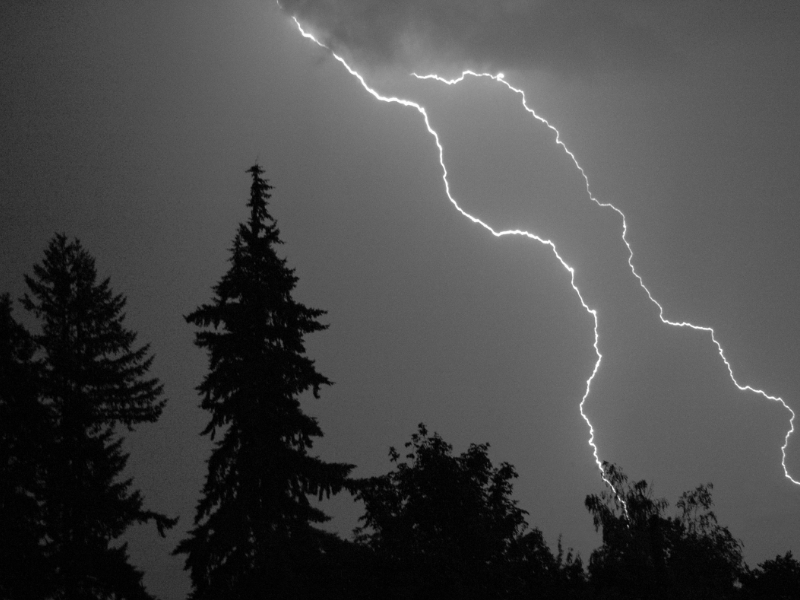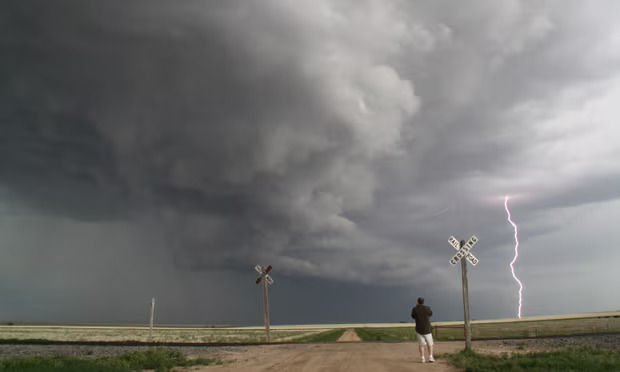



Every summer, outdoor event coordinators, athletic directors, golf course managers, and park supervisors invoke the same protocol: count to thirty after a lightning flash, and if you hear thunder, clear the field. Then wait thirty minutes after the last strike before resuming. This is the 30-30 rule, and for decades it has functioned as the default standard for lightning safety across North America that anyone can afford because it requires no tools.
The rule is simple, which explains its durability. But simplicity is not the same as sufficiency. The science underpinning the 30-30 rule was always limited, and the safety establishment has known this for some time. NOAA itself no longer formally promotes it. Yet it persists in some stadium protocols, sports association guidelines, school safety plans, and public signage across the continent, often standing in for the more sophisticated protocols that modern lightning science demands.
This article examines what the 30-30 rule actually says, where it came from, why the agencies that once endorsed it have moved on, and what a genuinely protective lightning safety standard looks like in practice. The answer involves moving from lightning detection, which is inherently reactive, to lightning prediction, which is the only methodology capable of warning people before a first strike.
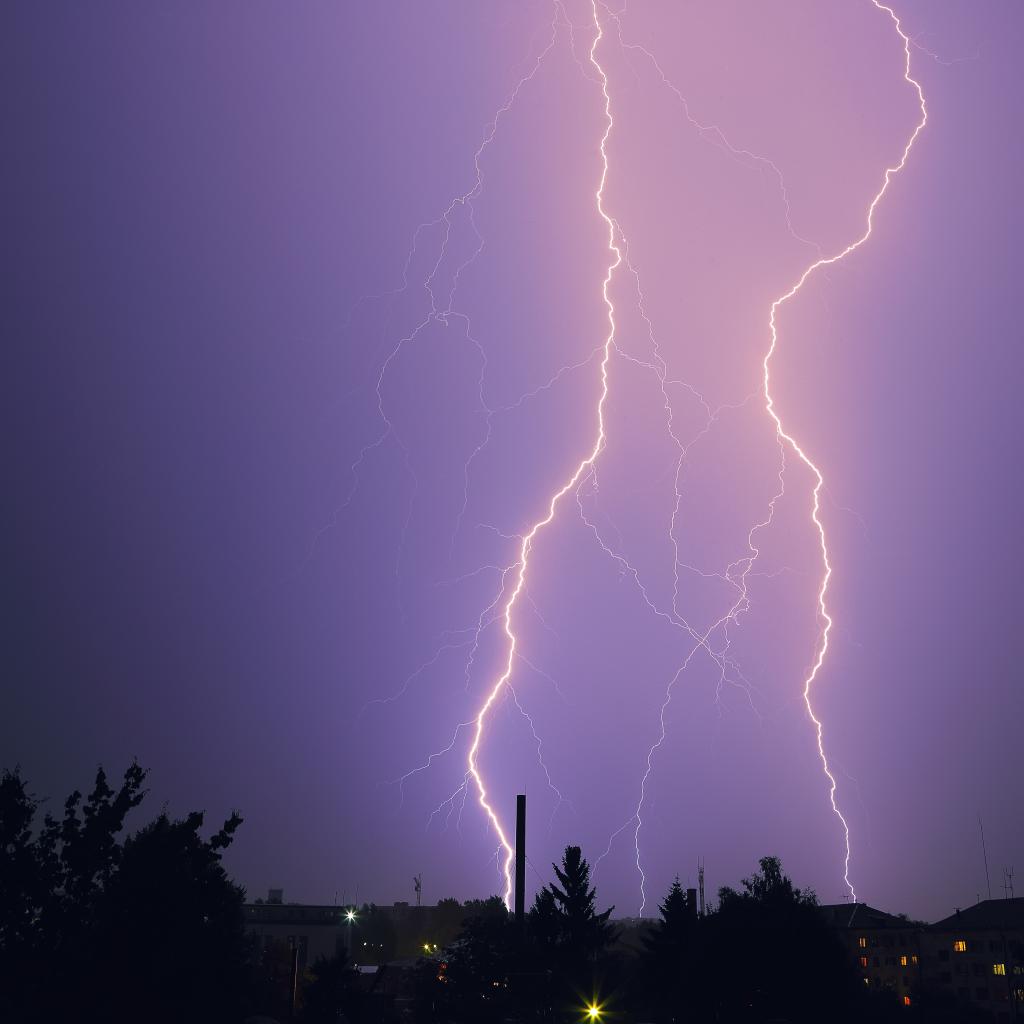
What the 30-30 Rule Actually Says
The 30-30 rule is a two-part protocol built around the acoustic relationship between lightning and thunder. Sound travels approximately one mile every five seconds. A thirty-second gap between a visible flash and audible thunder places the lightning roughly six miles away, which for many years was treated as the threshold at which a storm becomes immediately dangerous.
The first 30 tells you when to act: if the interval between lightning and thunder is thirty seconds or less, the storm is within six miles and you should seek shelter immediately. The second 30 sets the all-clear benchmark: after the last observed flash or clap of thunder, wait thirty minutes before returning to outdoor activities.
For its time, the rule had genuine value. It gave people without instruments a concrete, easy-to-remember action threshold. Before the proliferation of weather apps, dedicated lightning monitoring systems, and real-time atmospheric data, any standardized protocol was better than ad hoc judgment. The rule spread quickly through sports organizations, summer camp systems, and outdoor recreation management precisely because it required no equipment and could be communicated in a single sentence.
But the protocol has two fundamental architectural flaws. The first is that it depends entirely on having already observed a lightning strike, meaning it activates only after danger is already present. The second is that the thirty-minute wait time is not derived from any measurement of local atmospheric conditions; it is an estimate, essentially a buffer chosen to feel conservative without any scientific grounding in what the local sky is actually doing.
Where the Rule Came From: A Century of Lightning Safety History
The flash-to-bang calculation that underlies the first part of the 30-30 rule dates back at least to 1909, when lightning-to-thunder distance estimates were used in safety contexts to determine whether a distant strike represented an immediate hazard. For roughly six decades, this remained informal guidance, transmitted through outdoor education, military training, and common sense rather than formal policy.
The 30-30 rule as a codified standard emerged from the lightning safety work of the 1990s. A coalition of meteorologists, emergency medicine physicians, and sports medicine professionals convened to produce formal Lightning Safety Guidelines for the United States. Published and distributed broadly through the journals of participating organizations, these guidelines established the 30-30 rule as part of a broader lightning safety action plan that included shelter protocols and the instruction that substantial buildings and fully enclosed metal vehicles were the only genuinely safer locations during a storm.
Position statements incorporating these guidelines were subsequently adopted by the National Athletic Trainers Association and the American Meteorological Society. The NCAA formalized its own version in Guideline 1D in 1998, and from there the rule propagated through athletic administration, school systems, and outdoor event management with remarkable speed.
The rule’s success was partly a function of timing. The 1990s saw significant growth in organized outdoor youth sports, summer athletic programming, and recreational event management at a scale that required codified safety standards. Organizations needed something they could put in a handbook, post at a field, and reference when making event suspension decisions under time pressure. The 30-30 rule fit that need precisely.
What did not accompany the rule’s spread was an equivalent dissemination of its stated limitations. The guidelines themselves included the disclaimer that no place outside is safe from lightning near thunderstorms and that the guidelines were not one hundred percent safe due to the random and unpredictable nature of lightning. That caveat rarely made it onto the field signage.
Why NOAA Abandoned the 30-30 Rule And What That Actually Means
NOAA’s current lightning safety guidance no longer centers on the 30-30 rule. The agency’s messaging has shifted toward a simpler and in some ways more conservative standard: when thunder roars, go indoors. Under this framework, any audible thunder, regardless of the flash-to-bang interval, is treated as a signal that lightning is within striking range and that shelter should be sought immediately.
The reasoning is straightforward. If sound travels one mile every five seconds, then thunder audible at the threshold of human hearing indicates lightning within roughly ten miles. Lightning can and does strike from that distance, particularly the class of strikes known as bolts out of the blue, which originate from the upper portions of storm cells and can travel significant horizontal distances before reaching ground. Waiting for a thirty-second interval before acting provides a false sense of graduated risk.
NOAA’s current guidance retains the thirty-minute post-storm waiting period before resuming outdoor activities, but the agency presents this as a general guideline rather than a measured safety threshold. The nuance matters: NOAA acknowledges that this is a standard of practice, not a scientifically derived interval derived from real-time atmospheric data.
The shift in NOAA’s messaging represents an implicit acknowledgment that the rule’s first component, the counting protocol, created a decision framework that was both operationally complex and structurally dangerous. Under the old rule, people were counting seconds in open fields and making real-time shelter decisions while standing in the exact environment they were trying to assess for risk. The simpler message, any thunder means go inside, removes that judgment call entirely.
What NOAA’s updated guidance does not fully address is the back-end problem: the all-clear determination. The thirty-minute wait remains standard, but it remains an estimate. For facilities with genuine safety responsibilities, an estimate is not sufficient.
The Specific Scientific Failures of the 30-30 Rule
The rule’s inadequacies are not abstract. They manifest in specific, documented failure modes that have contributed to lightning injuries and deaths in outdoor settings.
The six-mile threshold was always too short. A landmark 1998 study conducted for the Severe Storms Laboratory by Ron Holle and R.E. Lopez established that six miles was a new recommended safe minimum precisely because lightning can easily travel more than six miles from an active storm. The same research determined that eighty percent of all lightning injuries and deaths occur away from the storm’s rain shaft, meaning that most people struck by lightning had no visual cue from precipitation that danger was near. The six-mile standard in the 30-30 rule’s first component was designed for a scenario, rain-proximate lightning, that doesn’t account for the majority of actual strike incidents.
In response to this research, most modern lightning detection systems moved their warning thresholds to eight or ten miles. But detection is still detection: it requires a lightning strike to have occurred before any warning can be generated. The person standing in the field is still learning about a first strike only after it has happened.
The bolt-out-of-the-blue problem is significant and underappreciated. Positive lightning, which originates from the upper anvil regions of thunderstorm cells, carries substantially higher peak currents than typical negative lightning and can strike from apparently clear skies well ahead of or behind the visible storm. These strikes are unpredictable under a flash-to-bang counting protocol because they may produce no observable precursor flash visible to someone standing at ground level in a different location from the strike origin. Detection systems have no advance warning for them either.
The back-strike problem undermines the second half of the rule. As a storm moves through an area, it discharges electrical energy repeatedly. In some cases, unused energy fields remain behind as the storm recedes, accumulating on metallic structures, tall trees, light poles, and flagpoles. These standing fields can connect with a leader from the retreating storm and produce a back strike, sometimes well after the visible storm has moved on. The thirty-minute wait was not calibrated to account for this phenomenon; it was a conservative buffer without a data foundation. A facility could reach the thirty-minute mark, clear personnel back to the field, and still be at risk if local electrostatic energy has not dissipated.
The rule also has a structural problem that compounds all of the above: it requires observation of a lightning flash to initiate. If the first strike in a fast-developing storm hits before anyone counts to thirty, the rule provides no protection for that first strike at all. Someone following the protocol perfectly could be struck by the very lightning that was supposed to trigger their countdown.
Why the Rule Persists Despite Its Known Limitations
Given the documented inadequacies of the 30-30 rule, its continued dominance in institutional safety protocols requires explanation.
The most important factor is institutional inertia. Safety protocols are adopted during periods of apparent urgency, embedded in governing documents, incorporated into staff training, printed on permanent signage, and then left in place because the cost of revision, both financial and organizational, is perceived as high. The organizations that adopted the 30-30 rule in the 1990s built it into their operating procedures at a time when it represented the professional standard. Updating that standard requires acknowledging that the old standard was inadequate, which carries liability implications many organizations would rather avoid.
Simplicity also functions as a preservation mechanism. The 30-30 rule can be communicated to a summer camp counselor in thirty seconds. It requires no equipment, no training beyond basic instructions, and no judgment more sophisticated than counting. Prediction-based protocols require either a monitoring system or at minimum a working understanding of what atmospheric electrostatic data means. For organizations without dedicated safety infrastructure, the rule fills a gap that would otherwise be empty.
The absence of formal regulatory replacement compounds the persistence problem. NOAA moved away from the 30-30 rule as a specific protocol, but did not replace it with a mandated alternative that organizations are required to adopt. When any thunder means go inside became the new message, it was disseminated as education rather than enforcement. Organizations operating under the older protocol were not compelled to revise their guidelines.
There is also the false equivalence problem. Many organizations that have adopted lightning monitoring systems assume those systems validate a detection-based protocol. If a horn sounds after a strike is detected eight miles away, the thirty-minute clock starts on the last detection in that range. But detection-based systems still cannot measure whether local electrostatic conditions have cleared. They can only tell you when the last detected strike occurred at a given radius. The system may provide earlier warning than pure flash-to-bang counting, but it is still operating within the structural limits of detection rather than prediction.
What Should Replace the 30-30 Rule: The Prediction-Based Protocol
The alternative to detection-based lightning safety is electrostatic prediction, and it is not a theoretical concept. It has been operational for more than fifty years.
Thor Guard, the world leader in lightning prediction warning systems, has provided on-site lightning prediction since 1974. The core distinction between Thor Guard’s technology and detection-based systems is foundational: Thor Guard measures changes in the electrostatic field in the atmosphere before any lightning strike occurs. Lightning originates within that electrostatic field, and the energy required to produce a strike builds over time in ways that are measurable with appropriate instrumentation.
By reading the activity within the electrostatic field through proprietary algorithms developed across millions of hours of thunderstorm monitoring, Thor Guard systems can warn that lightning conditions are developing in a defined area before a first strike occurs. The difference between a detection system and a prediction system is not a matter of degree; it is a categorical difference in what the system is capable of protecting against.
A detection system requires an actual lightning strike to occur before a warning is issued. Thor Guard can issue its warning before that first strike. For facilities with genuine safety obligations, the first strike is the most dangerous moment in any storm cycle because people are typically still outdoors, operating under the assumption that no observed lightning means no immediate risk. That assumption is precisely what prediction technology is designed to correct.
The practical advantages extend to the all-clear side of the protocol as well. Because Thor Guard measures local electrostatic conditions continuously, it can issue an all-clear when measured energy drops below the threshold at which a return strike is possible. This is a data-based determination, not a thirty-minute estimate. In cases where no residual energy remains after a storm passes through, the all-clear can come substantially earlier than a detection-based thirty-minute wait. In cases where significant residual energy persists, the all-clear is appropriately delayed until conditions actually justify it.
Thor Guard’s technology has been deployed at facilities across every relevant sector. It has served as the lightning safety system of choice for the USGA, the Atlanta Olympics, NASA, forty-eight U.S. military installations, Air Canada, Delta, American Airlines, and more than seven hundred universities, schools, and municipalities. The TG 360, Thor Guard’s most advanced system, samples the electrostatic atmosphere at more than 170,000 samples per second, integrating real-time lightning prediction and detection with an onsite weather station, mobile app notifications, and automated warning horn systems.
The applicable standard for any organization with a genuine obligation to protect people from lightning exposure is not the simplest protocol available. It is the protocol that is most likely to protect people from the first strike, not just the subsequent ones, and from back strikes after a storm’s visible activity has ceased. That standard is prediction, not detection.
Conclusion
The 30-30 rule was not a bad idea for its era. It codified a safety instinct into a communicable protocol and pushed lightning awareness into contexts that had none. But it was always a proxy measure, built on acoustic distance calculations and conservative time buffers rather than direct measurement of the atmospheric conditions that produce lightning.
The rule has been superseded, implicitly by NOAA’s updated guidance and explicitly by the development of electrostatic prediction technology that can warn of lightning before any strike occurs. Its continued dominance in institutional safety protocols reflects the predictable inertia of organizations that adopted it in the 1990s and have not faced regulatory pressure to update their standards.
The science has moved. The argument for detection-based protocols as adequate lightning safety practice has not improved; it has weakened. Facilities that retain the 30-30 rule as their operative standard are not making an evidence-based safety decision. They are accepting a known limitation because replacing it requires acknowledging the limitation in the first place.
When the question is how many seconds until you should seek shelter, the answer is already too late. A prediction-based system asks a more useful question: what is the local electrostatic atmosphere telling us right now? That is the question that can actually protect people from the first and last bolt.